Groove and Bounce (Why Your Moves Look Stiff)
Two people can perform identical choreography and one looks like a dancer while the other looks like someone executing instructions — the difference is groove, and it is almost never taught explicitly. Here is why beginners look stiff, what groove actually consists of, and how to practise it.
Why Beginners Look Rigid
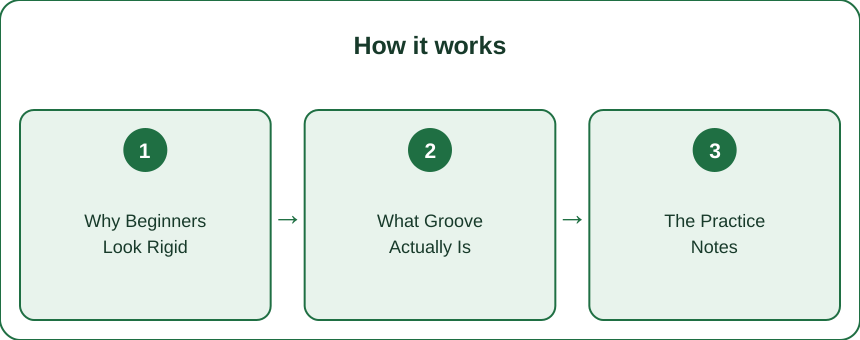
Executing rather than moving: the the-you-are-concentrating-on-the-steps (the mental load of remembering choreography producing tension from the beginner-moves logic — the concentrating-on-steps), the the-tension-kills-groove (the muscular tension being the direct opposite of groove from the musicality logic — the tension-kills-groove), the the-the-body-is-not-moving-underneath-the-moves (the the underlying bounce being absent from the musicality logic — the no-underlying-movement), the the-nobody-teaches-the-groove-explicitly (the groove being assumed rather than taught from the musicality logic — the not-taught-explicitly), the the-it-is-not-about-the-moves-themselves (the the moves being identical in both cases from the freestyle-confidence logic — the not-the-moves), and the reframe (the stiff-looking dancing as a groove problem rather than a choreography one — the moves being identical, with tension and an absent underlying bounce making the difference).

What Groove Actually Is
The layer underneath: the the-a-constant-bounce-underneath-everything (the continuous subtle bounce running under every move from the musicality logic — the constant-bounce), the the-a-down-or-up-bounce-on-the-beat (the the bounce landing on or against the beat from the musicality logic — the bounce-on-the-beat), the the-relaxation-in-the-joints (the loose knees, ankles and shoulders from the beginner-moves logic — the relaxed-joints), the the-the-weight-shifting-continuously (the weight moving between feet constantly from the beginner-moves logic — the weight-shifting), the the-the-upper-body-responding-to-the-lower (the the torso following the legs rather than being held from the musicality logic — the upper-follows-lower), the the-breathing-rather-than-holding-your-breath (the held breath producing visible rigidity from the freestyle-confidence logic — the keep-breathing), and the the-it-is-a-feel-not-a-position (the groove being continuous rather than a series of shapes from the musicality logic — the feel-not-positions).
The Practice Notes
Building it: the the-practise-the-bounce-alone (the drilling the bounce with no choreography at all from the musicality logic — the bounce-alone), the the-bounce-while-doing-ordinary-things (the finding the bounce while standing or waiting from the musicality logic — the bounce-anywhere), the the-learn-choreography-then-add-groove (the layering groove on once the steps are automatic from the beginner-moves logic — the steps-then-groove), the the-slow-the-music-down (the practising slowly to feel the bounce from the beginner-moves logic — the slow-it-down), the the-watch-the-body-not-the-arms (the observing dancers’ torsos rather than their arms from the musicality logic — the watch-the-body), the the-freestyle-to-build-the-feel (the freestyling developing groove faster than choreography from the freestyle-confidence logic — the freestyle-builds-it), the the-it-takes-time-and-listening (the groove developing through music exposure from the musicality logic — the takes-listening), and the frame (the groove as the continuous bounce underneath the moves — practised alone, with relaxed joints and shifting weight, and layered on once the steps are automatic. Practise the bounce with no choreography, keep your joints relaxed and weight shifting, and add groove once the steps are automatic).
Two people can perform identical choreography and one looks like a dancer while the other looks like someone executing instructions — the difference is groove, and it is almost never taught explicitly. Beginners look rigid because they are concentrating on the steps, tension kills groove, the body is not moving underneath the moves, nobody teaches groove explicitly, and it is not about the moves themselves. Groove is a constant bounce underneath everything, a down or up bounce on the beat, relaxation in the joints, weight shifting continuously, the upper body responding to the lower, breathing rather than holding your breath — a feel rather than a position. Practise the bounce alone, bounce while doing ordinary things, learn choreography then add groove, slow the music down, watch the body not the arms, and freestyle to build the feel.
Keep Reading
This article is for general informational and styling purposes only. Fit, sizing, and product availability may vary.