Why You Can Do the Move Alone But Not in the Combo
Quick Answer: A move performed in isolation and the same move inside choreography are different motor tasks. In a combo you must arrive in the right position, at the right moment, with residual momentum from the previous move. Practising the move alone trains none of that. Practise transitions, not steps.
You drilled it at home. Alone, in front of the mirror, it looks like the video.
In class, in the run-through, it turns into something vague that happens roughly on the right count. This is one of the most universal experiences in dance and it has a clean explanation.
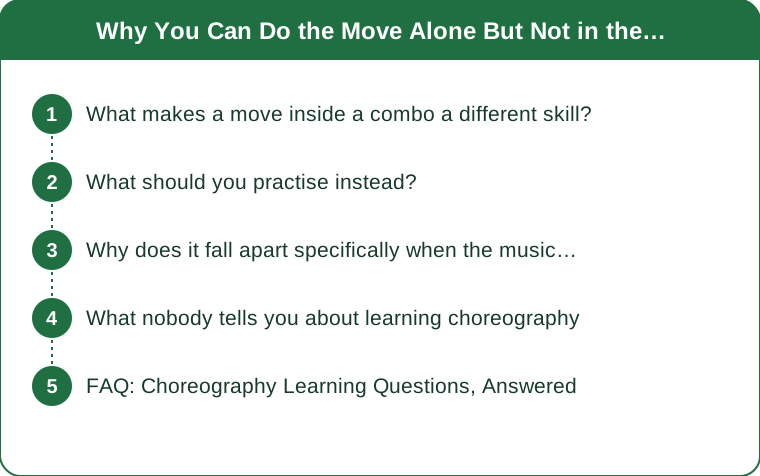
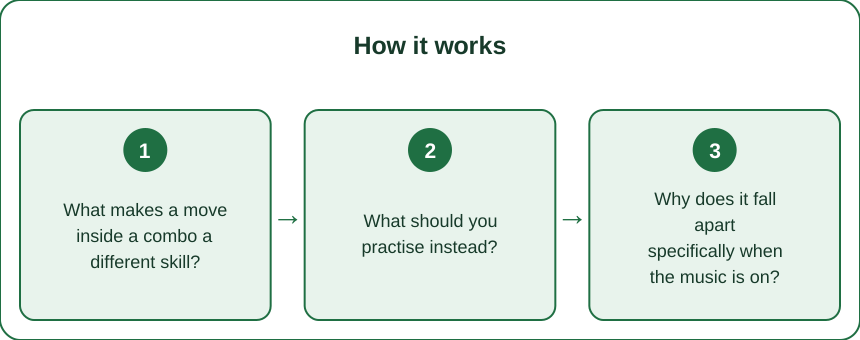
What makes a move inside a combo a different skill?
Three things you did not train when you practised it alone.
Entry position. Isolated practice starts from neutral: feet where you want them, weight centred, arms wherever is convenient. In the combo, you arrive at the move from whatever the previous move left you with — weight on the wrong foot, torso still rotating, arms mid-path. The move you rehearsed starts from a position you never actually reach.
Residual momentum. Movement carries. The end of one step feeds energy into the next, and choreography is largely about managing that. A move drilled from stillness has no incoming momentum to absorb or redirect, so when it suddenly does, the timing and force are wrong.
Timing pressure. Alone, you begin when you are ready. In a combo, the count begins whether you are ready or not, and the preparation you were unconsciously giving yourself has to fit inside the previous beat.
Motor learning research is consistent here: skills are encoded with their context. Practising in one context transfers only partially to another. This is why drilling a move in isolation for an hour can produce almost no improvement in the combo.
What should you practise instead?
Transitions — specifically the last beat of the previous move and the first beat of the target move.
The two-count drill. Take only the final count of the preceding move and the first count of the problem move. Loop those two counts, slowly, twenty or thirty times. This is the highest-return practice in choreography learning and almost nobody does it, because it feels like practising nothing.
Practise the exit, not just the entry. If a move keeps going wrong, check whether the actual failure is in the move before it, leaving you in the wrong place. This is the case surprisingly often.
Run at 60 percent speed with full commitment. Slow practice with full body engagement builds the correct pattern. Slow practice performed limply builds a limp pattern that you then try to speed up.
Mark the whole combo, full-out the problem section. Marking — running through at low intensity indicating the movements — rehearses sequence and timing without the fatigue cost, so you can do far more repetitions of the ordering.
Count out loud. Speaking the count externalises the timing and stops you drifting into your own internal tempo, which is the usual reason a move is right but half a beat late.
Why does it fall apart specifically when the music is on?
Because music removes the self-pacing that isolated practice relies on, and adds a second stream of information to process.
When you practise alone in silence, you unconsciously set the tempo to whatever your current skill supports. The move looks clean because you are running it at the speed you can run it cleanly. Music imposes an external tempo, and any gap between your speed and the track’s becomes visible immediately.
Music also adds cognitive load. You are now tracking the count, the phrase, the accents, and the choreography simultaneously. Under load, the least-automated element degrades first — which is the move you have practised least in context.
There is a useful diagnostic in this. If a move is clean in silence, clean when counted aloud, and falls apart with music, the issue is attention rather than technique. If it is imperfect even in silence at slow speed, it is technique and needs isolated work first.
The order that works: clean it slowly in isolation, then attach it to the transitions, then add counting, then add music at reduced tempo, then full tempo. Skipping straight from isolation to full-speed music is the standard mistake and it is why the same move stays broken for weeks.
What nobody tells you about learning choreography
The people who pick up combos fastest are not learning faster — they have more patterns stored. After a few years, most choreography is a recombination of movements you already own, so learning becomes recognising rather than building. This is why progress feels exponential rather than linear, and why the first year is disproportionately hard.
Watching is practice. Observing choreography activates overlapping neural systems to performing it. Watching a clip carefully several times before attempting it genuinely improves the first attempt.
Your worst run is usually the third. First run: cautious and reasonably accurate. Second: better. Third: your brain starts predicting ahead and adds errors. Most people conclude they are getting worse and stop. Push through to the fifth or sixth.
Filming yourself is uncomfortable and irreplaceable. Internal feedback about body position is unreliable in dynamic movement, and the mirror only shows you the front at the moment you are looking. Two clips per session shortcut weeks of guessing.
Sleep consolidates choreography. Motor sequences reorganise during sleep, which is why a combo learned on Tuesday is often better on Wednesday with no practice in between. Learning something the night before performing it works better than cramming the morning of.
FAQ: Choreography Learning Questions, Answered
How long should it take to learn an eight-count?
For most intermediate dancers, a straightforward eight-count is roughly right within 15 to 30 minutes of focused work and clean within a few sessions. Complex footwork or unfamiliar styles take considerably longer. If it is not landing at all after a full session, break it into two-count fragments rather than continuing to run the whole thing.
Should I learn the whole combo before cleaning any of it?
Learn the sequence roughly first, so you know where everything sits, then clean section by section. Cleaning as you go tends to produce a beautiful first eight-count and a vague ending, because you run out of class time.
Is it normal to be worse in class than at home?
Extremely, and it is not just nerves. Class adds mirrors at a different angle, other dancers in your peripheral vision, a different floor, and social pressure. Performance under those conditions is a separate skill that improves with exposure. Getting to the front row occasionally, uncomfortable as it is, accelerates it more than anything else.
TL;DR:
- A move in a combo is a different task: different entry position, incoming momentum, and externally imposed timing.
- Practise the last count of the previous move plus the first count of the problem move, on a loop.
- Progress from silent slow work to counting aloud to slowed music to full tempo — do not skip steps.
- Your third run is usually your worst; keep going to the fifth or sixth.
The move was never broken. It was only ever rehearsed from a starting position that the choreography does not provide.
Keep Reading
This article is for general informational and styling purposes only. Fit, sizing, and product availability may vary.