Why the Same Choreography Feels Different in a Different Studio
Quick Answer: Movement is learned in context, not in isolation. Floor surface changes how much you can slide and push, mirror position changes where your reference point is, room size changes your spacing, and sound systems introduce different delay. A routine encoded in one room genuinely has to be partly re-encoded in another — which is a normal feature of motor learning, not a sign you never learned it.
The more variable your practice, the less this happens.
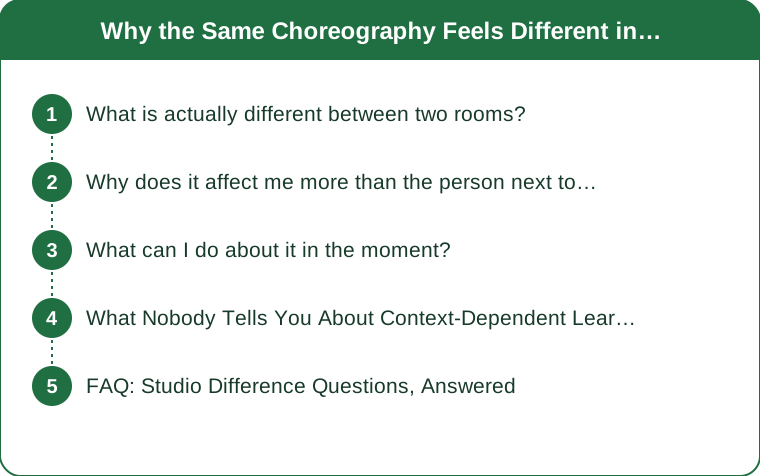
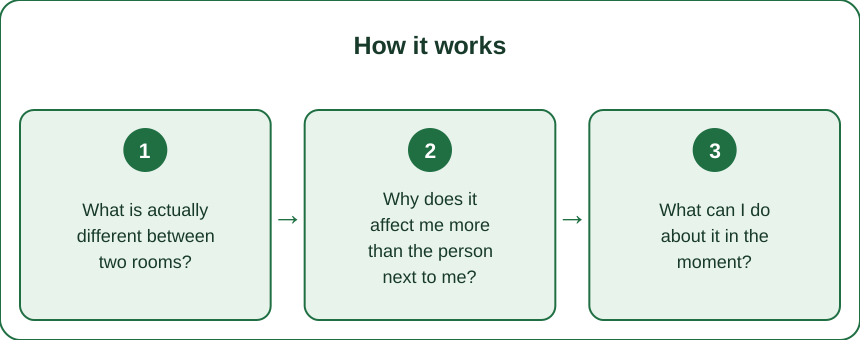
What is actually different between two rooms?
The floor decides your footwork. Sprung marley slides; vinyl over concrete grips; a wooden studio floor sits between them. Any move involving a slide, a pivot or a hard stop changes when the friction changes.
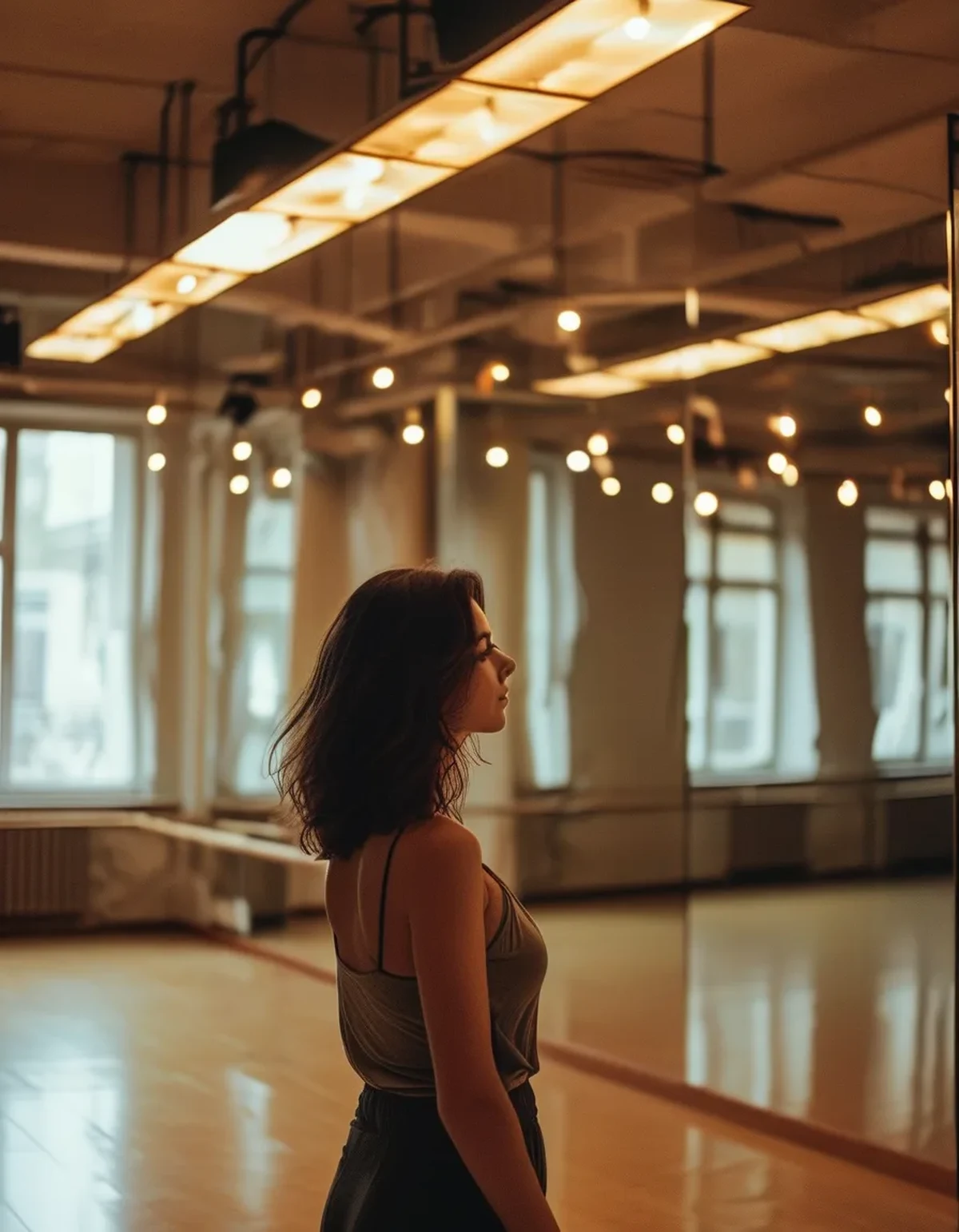
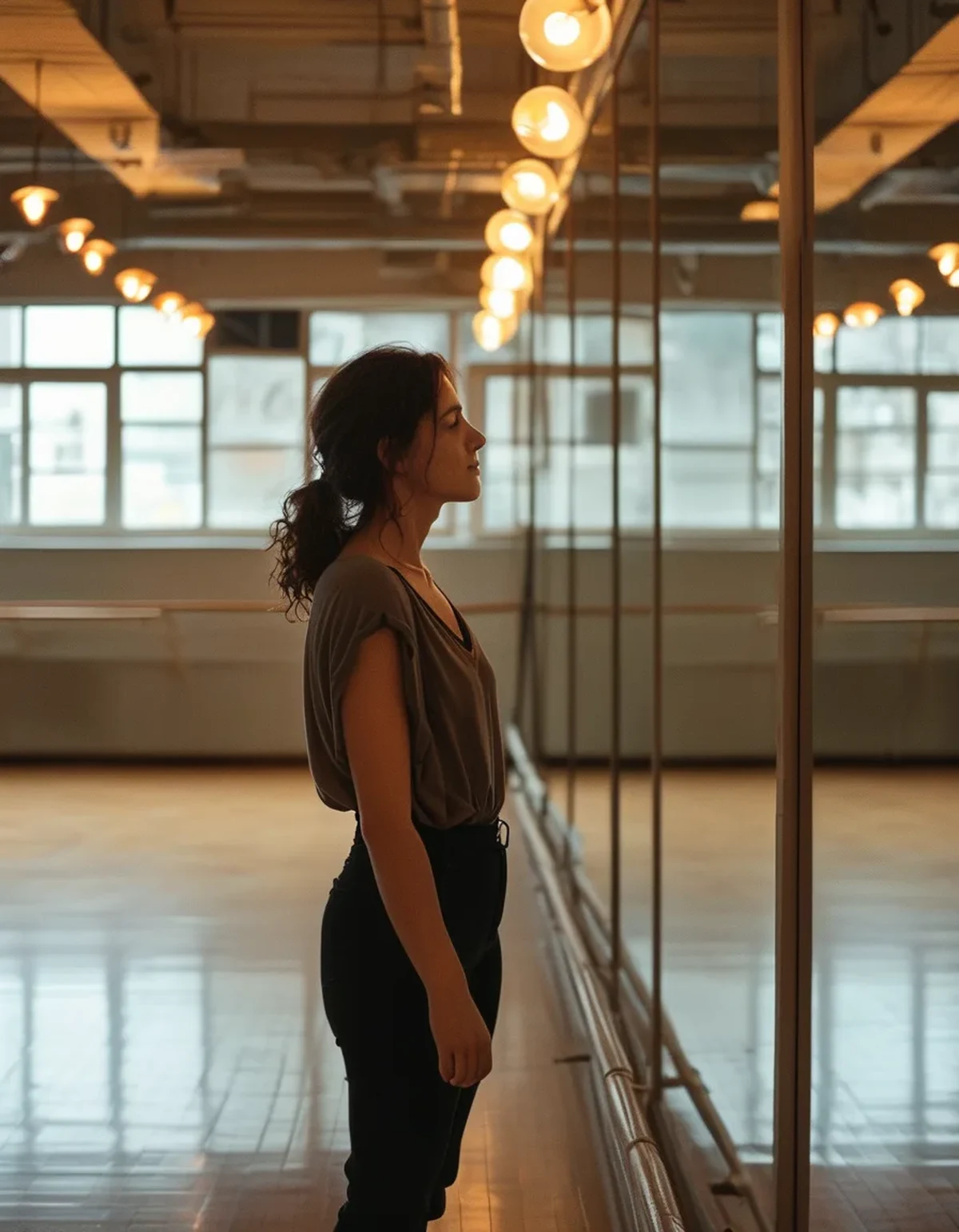
Mirror position rewires your reference. If you learned facing a mirror and the new room has it on the side, you lose the visual feedback loop you were unconsciously using to time and place the movement.
Room size changes travel. Choreography that travelled four steps in a large studio has to be compressed in a small one, and compression changes weight shift, which changes everything downstream.
Sound is not identical. Speaker placement, room reverb and the delay between speakers and your position all shift where the beat lands for you by tens of milliseconds — enough to feel late without being able to say why.
Why does it affect me more than the person next to me?
Because learning is contextual and some people encode context more heavily. Dancers who learned mostly in one room with one mirror have a more room-dependent version of the material.
Experience level matters. More experienced dancers have practised the same movement in more contexts, so their version is less tied to any single one.
Front-row versus back-row learners differ. If you habitually learn from the back, you are relying on the person in front as a timing reference. Move to a different room and a different formation, and that reference disappears.
Height and reach change spacing needs. A room that works for the majority can be genuinely too tight for a taller dancer, and that is a real constraint rather than a confidence issue.
What can I do about it in the moment?
Test the floor before class starts. Two slides and a pivot tells you what you are working with, and it takes ten seconds.
Mark the routine once at half size before running it full out. Marking re-establishes the sequence without asking your body to commit to a spatial pattern that may not fit.
Find your spacing landmark. Pick a fixed point in the new room and place yourself relative to it. Dancers who do this consistently adjust to new rooms far faster.
Adjust travel, not timing. If the space is tight, shorten the steps and keep the count. The common error is speeding up to fit the space, which puts you ahead of the music.
Give the sound one full run. Your sense of the beat recalibrates quickly, but not instantly, and the first run in a new room is usually the worst one you will do all session.
What Nobody Tells You About Context-Dependent Learning
Practising in one place makes you better in that place, specifically. Variable practice — different rooms, different surfaces, different sides of the mirror — produces worse practice sessions and much better transfer. This is one of the most consistent findings in motor learning and almost nobody applies it to dance deliberately.
Learning without the mirror is the highest-leverage change. Mirror dependence is invisible until it is removed, which is usually at a performance, a showcase, or a film shoot, and by then it is too late to discover it.
Filming yourself in each new room helps twice. It shows you what actually changed, and it gives you a version of the routine you can review outside the room, which weakens the context binding.
Performing is always a new room. Stage, no mirror, different floor, different sound, an audience. If your routine only exists in your usual studio, performance is where you find out.
And the reassuring one: the adjustment period for a new room is typically one or two runs, not a session. If it takes longer than that, the issue is usually spacing rather than memory, and spacing is fixable with a landmark.
Autumn brings a specific version of this. New terms mean new class times, new rooms and new formations all at once. A routine that feels lost in the first September class is usually intact and simply displaced.
FAQ: Studio Difference Questions, Answered
Should I always stand in the same spot in class?
For learning, moving around is better. Consistently standing in one spot builds a version of the choreography that depends on that sightline and that neighbour.
Why do I dance better in the back row?
Usually a mix of reduced self-consciousness and having a timing reference in front of you. The second one is the part worth training out, because it disappears the moment you move forward.
Does floor type really change my technique?
Yes, measurably, for anything involving slide, pivot or a hard directional change. It also changes impact loading, which is why a hard floor produces more soreness after the same class.
TL;DR:
- Floor friction, mirror position, room size and sound delay all change how a routine executes.
- Motor learning is context-dependent, so a routine partly has to be re-encoded in a new room.
- Test the floor, mark it once, and pick a spatial landmark before running full out.
- Adjust travel distance, never the timing — speeding up to fit is the common error.
- Practise in varied rooms and without the mirror; worse sessions, far better transfer.
You did not forget it. You learned it somewhere else.
Keep Reading
This article is for general informational and styling purposes only. Fit, sizing, and product availability may vary.