Afraid to Freestyle in Hip-Hop Dance Class? Here's Why — and How to Actually Get Past It
Quick Answer: Freestyle fear usually comes from the shift between following set choreography (a clear right-or-wrong answer) to generating original movement (an open-ended, judgment-exposed task) — it’s a distinct skill most students never explicitly practice. Starting with small, structured freestyle prompts rather than open-ended ‘just move’ sessions builds the skill fastest.
Students who nail every choreographed combo often freeze completely when the music stops and freestyle time starts. That gap is common and explainable — freestyle is a genuinely different skill from following choreography, not just a harder version of the same thing.
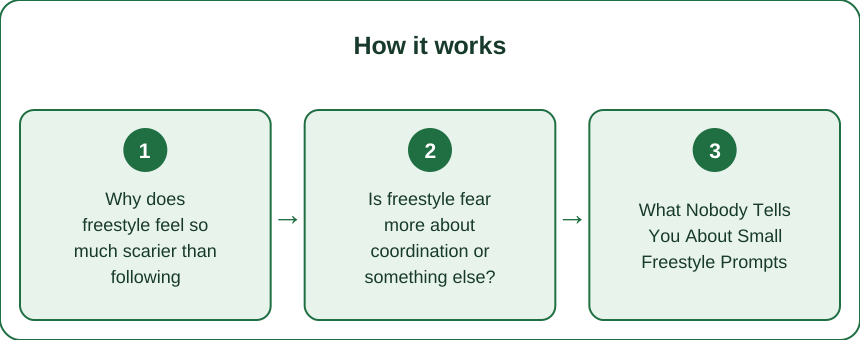
Why does freestyle feel so much scarier than following choreography?
Choreography has built-in right answers — you’re evaluated on how accurately you match a known pattern, which is a clear, bounded task. Freestyle removes that structure entirely, replacing it with open-ended self-generated movement, which exposes personal choice and creativity in a way that feels much more personally revealing and judgment-prone.
This is a genuinely different cognitive and creative skill, not simply choreography without a script — which is why being excellent at combos doesn’t automatically transfer to freestyle comfort.
Is freestyle fear more about coordination or something else?
Almost always something else — fear of judgment and the pressure of pure self-expression is the dominant factor, not physical coordination. Many strong technical dancers freeze specifically because they’re used to being evaluated on precision, and freestyle removes that familiar evaluation framework entirely.
This is why simply ‘having good rhythm’ doesn’t predict freestyle comfort well — the block is usually more psychological and unfamiliar-task-related than physical.
What Nobody Tells You About Small Freestyle Prompts
Here’s what most classes skip: jumping straight to open-ended ‘just freestyle for 8 counts’ is actually one of the hardest possible entry points. Much more effective is starting with tiny, structured prompts — ‘freestyle using only your arms,’ ‘repeat one simple move with small variations,’ or ‘freestyle for just 2 counts, then rest’ — which build the skill in small, low-pressure increments rather than demanding full creative output immediately.
Most dancers who eventually become comfortable freestyling report this kind of scaffolded practice, not sudden confidence, as what actually got them there.
What else genuinely helps build freestyle comfort over time?
- Practicing alone first, in a private space with no observers, before attempting freestyle in front of a class
- Recording yourself freestyling privately and reviewing it without judgment, purely to normalize watching your own unscripted movement
- Borrowing small movement vocabulary from combos you already know, remixing familiar steps rather than inventing entirely from scratch
- Accepting ‘simple and confident’ over ‘complex and hesitant’ — a few repeated, comfortable moves read better than an anxious attempt at something elaborate
FAQ: Hip-Hop Freestyle Fear Questions, Answered
Is it normal to feel worse at freestyle than at choreography, even after years of dancing?
Yes, very common — the two are genuinely different skills, and freestyle comfort often lags well behind choreography skill unless specifically practiced.
Does freestyling alone at home actually transfer to class settings?
Yes — building baseline comfort with your own unscripted movement privately generally transfers, though performing in front of others is still its own additional step to practice.
How long does it typically take to feel more comfortable freestyling?
Most people report a meaningful shift within a few months of consistent small, structured practice — much faster than trying to force comfort through repeated open-ended attempts alone.
TL;DR:
- Freestyle fear comes from an open-ended, judgment-exposed task replacing choreography’s built-in right answers
- The block is usually psychological, not a lack of coordination or rhythm
- Small, structured freestyle prompts build the skill faster than jumping into open-ended sessions
- Practicing alone first and recording yourself privately both help normalize unscripted movement
Freestyle discomfort isn’t a dance skill gap — it’s an unpracticed, genuinely different skill that responds well to small, scaffolded practice.
Keep Reading
This article is for general informational and styling purposes only. Fit, sizing, and product availability may vary.