Why You Forget Choreography the Second You Leave the Studio
Quick Answer: Choreography feels solid in class because you’re relying on short-term muscle memory built through repetition in that exact session, which fades fast without reinforcement. Filming a quick run-through and reviewing it within a few hours, not days, converts that short-term memory into something that actually sticks.
You nailed the final run-through, felt like you had it, and by the time you’re home twenty minutes later you can barely remember the first eight counts.
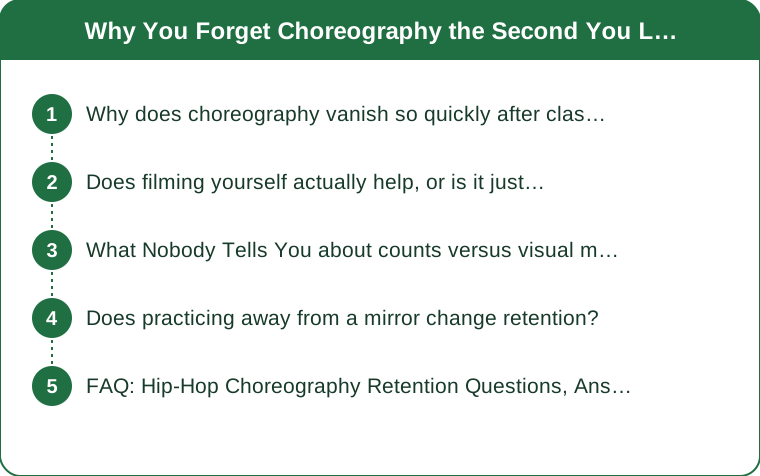
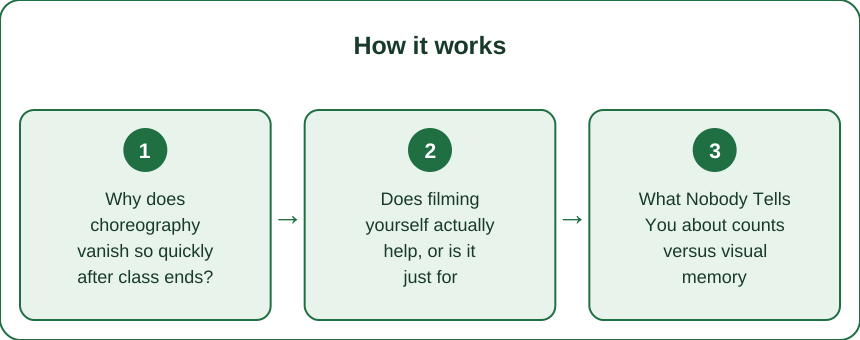
Why does choreography vanish so quickly after class ends?
Repetition during class builds short-term motor memory that’s still fragile and hasn’t been consolidated into longer-term retention, a process that actually happens during rest and sleep, not during the practice itself. Without reinforcement soon after learning, that fragile short-term memory decays within hours, which is exactly the window most people lose it in.
Does filming yourself actually help, or is it just for reference?
Filming does double duty — it gives you a reference to review, but the act of performing for the camera also slightly increases focus and encoding during that final run, similar to how performing for an audience sharpens execution. Watching that footage within a few hours of class, even just once, meaningfully improves next-class recall compared to not reviewing at all.

What Nobody Tells You about counts versus visual memory
Many dancers memorize choreography visually (mimicking shapes) rather than through counts, which works fine live in the room with music playing but falls apart when trying to recall it silently later without an audio or visual cue present. Learning the counts explicitly, not just the shapes, gives you a more portable memory that doesn’t depend on the room or the music being present.
Does practicing away from a mirror change retention?
Yes — mirror practice trains you to correct visually in real time but can create a dependency where you struggle to execute the same movement without that visual feedback loop. Occasionally practicing away from a mirror, relying on internal body sense, builds a more durable, less environment-dependent memory.
FAQ: Hip-Hop Choreography Retention Questions, Answered
How soon after class should I review notes or video?
Within a few hours is ideal, before the day’s other activities and sleep cycle fully process (and partially discard) the fragile short-term memory from class.
Does writing counts down on paper help as much as video?
For some people, yes — the act of translating movement into written counts forces a different kind of encoding that complements visual memory, particularly useful for those who think more verbally than visually.
Is it normal to need multiple classes to retain one combo?
Completely normal — most choreography, especially longer combos, needs 2-3 exposures spaced across separate sessions before it moves into durable long-term memory, regardless of how quickly you pick it up within a single class.
TL;DR:
- Choreography learned in class sits in fragile short-term memory that fades within hours
- Reviewing filmed footage within a few hours meaningfully improves retention
- Learning explicit counts, not just visual shapes, creates more portable memory
- Occasional mirror-free practice builds recall that doesn’t depend on visual feedback
Forgetting choreography fast is a memory-timing issue, not a sign you’re bad at picking up dance.
Keep Reading
This article is for general informational and styling purposes only. Fit, sizing, and product availability may vary.