How to Stop Overthinking Hip-Hop Choreography and Just Feel It
Quick Answer: Overthinking hip-hop choreo happens when your brain is still translating counts into moves instead of trusting muscle memory. Drill the choreography slow and silent first, then add music last — feel follows repetition, not concentration.
You know the steps. You’ve drilled them at home. Then the music starts in class and suddenly you’re two counts behind, staring at your own feet, dancing like a spreadsheet instead of a person. That disconnect isn’t a talent problem — it’s a sequencing problem in how you practiced.
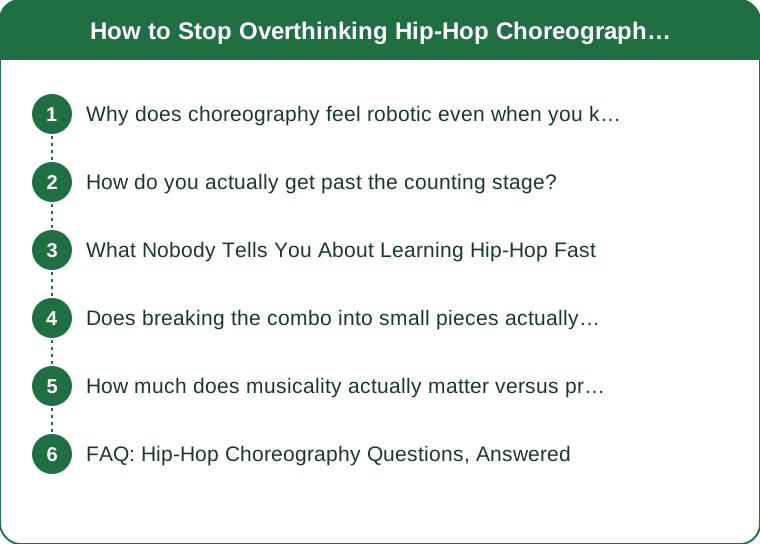
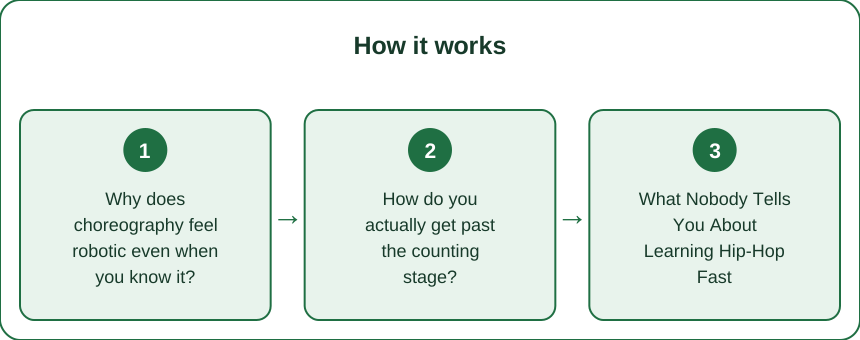
Why does choreography feel robotic even when you know it?
Because knowing the steps and owning the steps are two different skill levels. Knowing means you can recall the sequence if you concentrate hard enough. Owning means your body executes it while your brain is free to focus on music, energy, and facial expression.
Most dancers stop practicing right after they hit ‘knowing’ — right when the choreography still needs full conscious effort to execute. That’s exactly the stage where it looks stiff, because there’s no processing power left over for feel.
How do you actually get past the counting stage?
Drill in silence first. Run the combo with no music, counting out loud, until you can do it while thinking about something else — literally have a conversation mid-run-through. That’s the test for muscle memory, not ‘3 times through felt okay.’
Only then add music. The first few times with music, you’ll likely fall slightly behind — that’s normal recalibration, not failure. Give it 3-4 run-throughs before judging.
What Nobody Tells You About Learning Hip-Hop Fast
Video-recording yourself and comparing to the instructor is the single fastest way to close the feel gap, and almost nobody does it because it’s awkward to watch yourself. Your brain’s sense of your own timing is unreliable — dancers who feel on-beat are frequently a half-count off on video, and can’t fix what they can’t see.
Record one run-through per class. Watch it once, note one thing, move on. Don’t spiral on it.

Does breaking the combo into small pieces actually help?
Yes, and it’s the part most self-taught dancers skip. Break an 8-count phrase into two 4-counts, drill each until it’s automatic, then link them. Trying to learn a full 32-count combo in one pass is why people default to counting under their breath through the whole thing.
Small chunks, repeated more times, beat full run-throughs repeated fewer times — every time.
How much does musicality actually matter versus precision?
In hip-hop specifically, musicality (hitting accents, playing with the beat, adding your own flavor) reads as more impressive than technical precision to almost every audience, including instructors. A slightly-off-count move performed with commitment and musicality looks better than a perfectly-counted move performed stiffly.
Once the steps are automatic, spend deliberate practice time on musicality alone — same combo, different songs, feeling where your body wants to accent.
FAQ: Hip-Hop Choreography Questions, Answered
How long does it take to stop overthinking choreography?
Most people reach automatic execution of a single combo after 5-8 focused silent run-throughs, spread across a few days — cramming it all in one session doesn’t build the same muscle memory.
Why do I forget choreography under pressure but not alone?
Performance anxiety pulls processing power away from movement recall, the same power you need for automatic execution. This is exactly why the silent-drilling stage matters — it makes the movement need less conscious processing in the first place.
Is it normal to feel behind the beat as a beginner?
Completely normal, and it usually resolves within a few classes of consistent practice. If it doesn’t shift after several weeks, working timing drills separately from choreography (clapping counts, stepping to a metronome) often unlocks it.
TL;DR:
- Knowing steps and owning steps are different stages — most people quit practicing right when it still needs full concentration
- Drill silent and slow until automatic, THEN add music
- Record yourself; your internal sense of timing is unreliable
- Break combos into small chunks repeated often, not full run-throughs repeated rarely
The feel isn’t a separate skill you’re missing — it’s what’s left over once the steps stop needing your full attention.
Keep Reading
This article is for general informational and styling purposes only. Fit, sizing, and product availability may vary.