Why Learning Choreography From Video Is Harder Than in Class
Quick Answer: Video removes four things a class gives you for free: mirroring correction, three-dimensional depth cues, real-time timing pressure, and peripheral learning from other dancers. The biggest single loss is depth. A flat screen cannot show you how far forward a chest movement travels or how much weight sits in one hip, so you copy the shape and miss the mechanic. The workaround is to learn the count structure first, then the weight shifts, and only then the shapes, which is roughly the reverse of how tutorials are edited.
You have unlimited rewinds, half speed, and a mirror view. In class you get the phrase four times and then everyone runs it.
And somehow the class version sticks better. That is not a discipline problem. Video is genuinely missing information that your body needs.

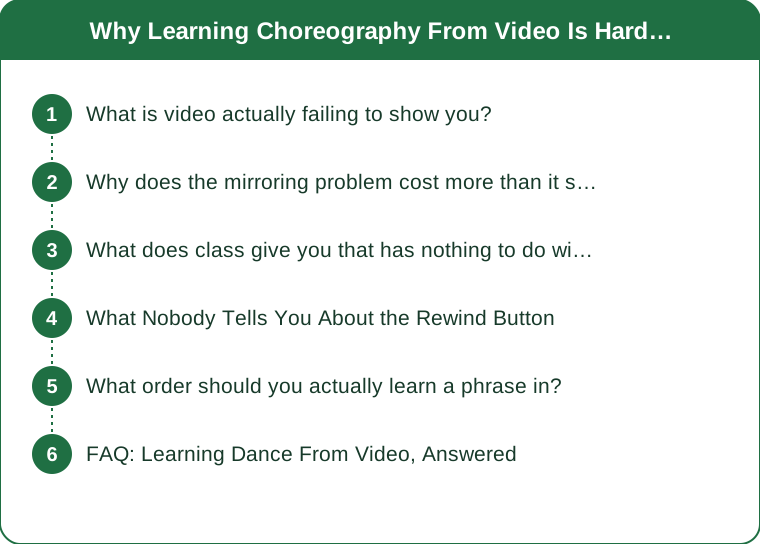
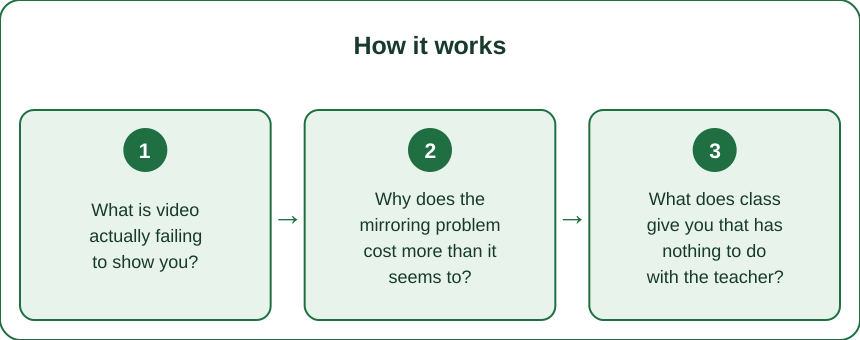
What is video actually failing to show you?
Depth, mostly. And depth is where hip hop lives.
A screen is a two-dimensional projection. What survives that projection is shape, meaning where limbs are relative to each other in the frame. What does not survive is anything traveling toward or away from the camera.
In hip hop specifically, an enormous amount of the vocabulary is depth-based: the chest coming forward and back, weight sinking into the back hip, the slight backward lean that makes a groove read as heavy rather than bouncy.
So you copy the frame accurately and it still looks wrong. Your arms are in the right place. Your chest is not traveling. The video showed you the outline and hid the engine.
This is also why side-angle footage, when tutorials bother to include it, is worth more than another front-angle repetition. If a tutorial only shows one angle, you are missing an entire axis of the movement.
Why does the mirroring problem cost more than it seems to?
Most tutorials solve mirroring by flipping the footage, so the instructor’s right becomes your right on screen. That helps with which side, and it introduces a subtler problem.
A mirrored video shows you a reversed version of the instructor’s body mechanics. Almost everyone has an asymmetric groove. Weight sits slightly more in one hip, one shoulder drops a bit further, one arm extends more fully. Mirror the footage and you are now copying a version of that asymmetry that never existed and does not correspond to how anyone actually moves.
In class, a teacher facing away from you shows the real thing. When they turn to face you, your brain does the flipping, which it is quite good at, and the mechanics stay intact.
Practical workaround: learn the phrase from unmirrored footage even though it feels harder at first. Use the mirrored version only to check which side you are on. The extra difficulty in week one buys you accuracy that carries.
What does class give you that has nothing to do with the teacher?
Peripheral learning, and it is a bigger share of class value than most people would guess.
When you learn in a room, you are absorbing information from the dancers around you continuously and mostly unconsciously. You catch timing from the person in your peripheral vision. You see three different bodies solve the same move, which teaches you which parts are essential and which are personal styling. You feel the collective count.
That last one is underrated. A room full of people hitting a count creates a physical timing signal through sound and air movement that your body syncs to more reliably than a metronome does.
Video gives you one body, one interpretation, and no ambient timing.
Partial workaround: learn from two different videos of the same style rather than watching the same one thirty times. Two interpretations of the same groove teaches you the invariant, which is what you actually want to learn. Thirty repetitions of one teaches you an impression.

What Nobody Tells You About the Rewind Button
Unlimited rewinds feel like an advantage. In practice they change how your brain encodes the movement, and not in your favor.
In class, you get four repetitions and then you must attempt it. That forced attempt, with incomplete information, is retrieval practice. Your brain has to reconstruct the movement from a partial memory, notice the gaps, and fill them on the next viewing. Retrieval is one of the most robust learning mechanisms known, across every domain that has been studied.
With a video, you can watch until you feel ready. That feeling is the trap. Watching produces fluency, meaning it feels familiar and easy, and fluency feels like knowing. It is not. You have built a strong visual memory and a weak motor memory.
This is why people can describe a phrase in detail and still not execute it.
The fix is to impose the constraint that class imposes on you:
- Watch a 4-count segment three times. Not four, not ten. Three.
- Close the laptop or turn away from the screen.
- Attempt it from memory, badly, all the way through.
- Only then go back and check.
The attempt feels wasteful because it is wrong. The wrongness is the mechanism. You will learn a phrase in twenty minutes this way that took an hour the other way.
What order should you actually learn a phrase in?
Roughly the reverse of how tutorials present it.
Most tutorials teach shape first, because shape is what a camera captures. Then they add timing. Then, if at all, they mention weight.
Learn it in this order instead:
1. Count structure, no movement. Watch the phrase once and just count out loud with it. Where do the hits land? Is it hitting on the count, just before, or lagging behind? Get this before you move at all. A phrase learned with wrong timing has to be unlearned, which takes longer than learning it right.
2. Weight shifts only. Walk through the phrase transferring weight foot to foot with no arms, no chest, no styling. This is the skeleton. If you cannot feel where the weight goes, no amount of arm accuracy will make it look right.
3. Torso and chest. Add the depth movements. This is where you will need to guess, since the video hid them. Guess bigger than looks right on screen. Depth movement reads smaller on camera than it is in the room, so if you match what you see, you are undershooting.
4. Arms and shapes last. These are the easiest to copy and the least important to the groove reading correctly.
5. Styling and personal texture, later still. Not on day one.
Season note: if you are returning to class after a summer break, this order matters even more. The shapes come back fast. The weight and timing come back slowly, and trying to run full-speed choreography before the weight returns is the most common way people conclude they got worse over the summer. They did not. The layers just recover at different rates.
FAQ: Learning Dance From Video, Answered
Why does choreography look right in my room and wrong on video?
Usually depth. Chest and weight movements travel less than you think when you learned from a flat screen, so the shape is accurate and the mechanic is undersized. Film yourself from the side to check.
Should I use mirrored or unmirrored tutorials?
Learn from unmirrored footage and use the mirrored version only to confirm which side you are on. Mirroring flips the instructor’s natural asymmetry into a version nobody actually dances.
How many times should I watch before trying?
Three times per short segment, then attempt from memory before watching again. Watching until you feel ready builds visual familiarity that feels like knowing but is not.
TL;DR:
- Video loses depth, which is where most hip hop mechanics live. You copy the shape and miss the engine.
- Mirrored footage flips the instructor’s natural asymmetry into something nobody actually dances.
- Class gives you peripheral timing and multiple interpretations for free. Two videos beats thirty views of one.
- The rewind button builds visual fluency that feels like learning. Force a from-memory attempt after three views instead.
- Learn in this order: counts, weight shifts, torso, arms, styling.
The class advantage is not the teacher being present. It is the constraints, and you can rebuild most of them on your own laptop.
Keep Reading
This article is for general informational and styling purposes only. Fit, sizing, and product availability may vary.