Why Your Footwork Is Clean and Your Upper Body Gives You Away
Quick Answer: Footwork is learned explicitly - counts, placement, weight transfer. Upper body movement is usually absorbed implicitly, so when you learn choreography by watching the feet, the top half defaults to holding still while you concentrate. Fix it by practising the upper body separately without any footwork, learning where the bounce originates, and deliberately putting your gaze and chest somewhere rather than leaving them neutral.
You can do the combination. The feet land exactly where they should.
Watch the video back and everything from the ribs up is doing nothing at all, or doing something small and apologetic.

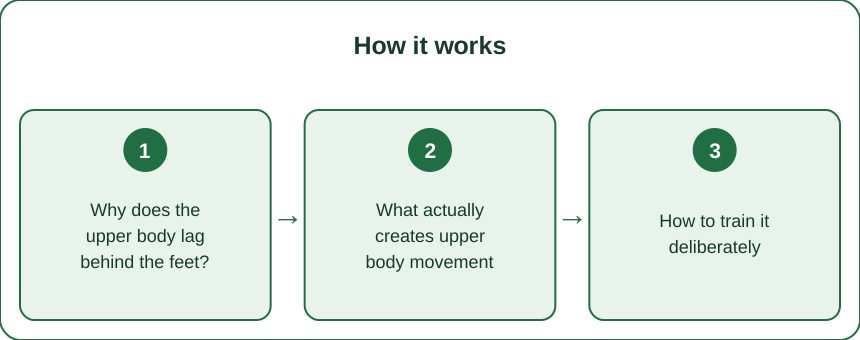
Why does the upper body lag behind the feet?
Feet are taught explicitly and the upper body is not. A teacher counts the footwork, breaks it down, and repeats it. The torso, arms, and head are usually demonstrated rather than described, so you copy the shape without ever being told the mechanic.
Attention is finite while learning. When you are concentrating on where your weight goes on count three, the top half is not being controlled - it is being held still, which is the brain’s default under cognitive load.
Holding still is an active choice that reads as stiffness. The upper body is not neutral in that state; it is braced, and bracing is visible from across a room.
The bounce is the specific thing that goes missing. Hip hop’s groove originates in a subtle knee and hip pulse that travels up through the torso, and when you concentrate on foot placement you stop the pulse at the hips.
Mirror practice reinforces it. Watching your own feet in the mirror drops your head, which locks your neck and upper back into exactly the position that reads as stiff.
And it is a sequencing issue, not a flexibility issue. Most people with a stiff-looking upper body in class have perfectly normal mobility - what they lack is a learned pattern connecting the lower body pulse to the torso.
What actually creates upper body movement
The bounce starts in the knees and ankles. Every groove in hip hop originates with a soft, continuous pulse in the lower body, and the torso movement is largely a consequence of that pulse travelling upward - not something you add separately on top.
A locked knee stops it dead. If your legs are straight and stiff while you do footwork, nothing can travel upward, and no amount of consciously moving your shoulders will look organic.
Ribs move independently of hips. The ability to shift the ribcage side to side and front to back over stable hips is a trainable isolation, and it is the single most useful one for making choreography look finished.
Shoulders follow the ribs, not the other way round. Trying to move the shoulders directly produces the tense, deliberate look. Move the ribs and let the shoulders respond.
The head is part of the choreography. Where you look is a performance choice, and leaving your gaze unfocused or on the floor removes a large part of what makes movement read as intentional.
And breathing changes everything visibly. Holding your breath through a combination locks the ribcage, which locks the shoulders. Breathing out on the accents is a small change with a disproportionate effect on how loose you look.
How to train it deliberately
Practise the upper body with no footwork at all. Stand still, do the torso, arms, and head parts of the combination on their own, and repeat until they are automatic. Then add the feet back.
Do the reverse too. Run the footwork while deliberately exaggerating the upper body beyond what the choreography asks for. Overshooting in practice tends to land at about right in performance.
Train the bounce as its own drill. Two minutes of a simple knee pulse to music, with no steps, letting the movement travel up through the torso until it feels continuous rather than added.
Isolate ribs and chest separately. Five minutes of rib isolations - side to side, forward and back, then circles - two or three times a week builds the pattern faster than any amount of full choreography.
Film from the side, not the front. The front view flatters upper body stillness; the side view shows exactly how much your torso is or is not moving, and it is uncomfortable and useful.
Learn the combination facing away from the mirror once. It forces you to feel the movement rather than check it, and feeling is what eventually produces a natural top half.
And pick where you look before you run it. Deciding your gaze in advance for each phrase converts a blank concentrating face into a performance, and it is the fastest visible improvement available.
Returning to class after a summer break? Expect the upper body to be the part that comes back last - it is the layer that gets dropped first when you are concentrating, and the first sessions back are all concentration.
What Nobody Tells You About Looking Loose
Looking relaxed requires more control, not less. The dancers who look effortless are actively managing more of their body than you are, not fewer parts of it. Loose is a skill, not an absence of effort.
Your face is part of your upper body. A concentrating face undoes a lot of good movement, and it is the thing most beginners are least aware of until they see video.
The stiffness is usually worst in the first eight counts. People settle in as a combination progresses, which means the opening - the part everyone watches most - is the weakest section. Practise entries specifically.
Arms feel enormous and read as small. What feels like an exaggerated arm movement usually looks moderate on camera. This gap is why teachers keep saying bigger and it never feels like it is working.
Tension travels upward from wherever it starts. Gripping the floor with your toes or clenching your jaw both show up as shoulder tension, and neither is where you would look for it.
And two weeks of isolation drills changes more than two months of extra choreography. The limiter is a missing movement pattern, not a missing combination, and practising more combinations does not build the pattern.
Everyone in the room is watching themselves, which is worth remembering when the reason you are holding still is self-consciousness rather than technique - which, honestly, it often is.
FAQ: Upper Body in Hip Hop, Answered
Why does my upper body look stiff when my footwork is fine?
Footwork is taught explicitly and the upper body is usually demonstrated rather than broken down. Under concentration, the default is to hold the top half still - and holding still reads as bracing.
Where does the bounce actually come from?
The knees and ankles. A soft continuous pulse in the lower body travels up through the torso. Straight, locked legs stop it before it can reach the ribs.
How do I loosen my shoulders?
Stop trying to move them directly. Move the ribcage and let the shoulders respond - direct shoulder movement is what produces the tense, deliberate look.
What is the fastest drill to improve this?
Rib isolations, five minutes two or three times a week, plus running the upper body of a combination with no footwork at all until it is automatic.
Why do I look worse in videos than in the mirror?
The mirror is a front view, which hides upper body stillness. Film from the side - it shows exactly how much your torso is moving, which is usually less than it feels.
Does flexibility have anything to do with it?
Rarely. Most people with a stiff-looking upper body have normal mobility. What is missing is a learned pattern connecting the lower body pulse to the torso, and that is trainable in weeks.
TL;DR:
- Footwork is taught explicitly and the upper body is not, so under concentration the top half defaults to holding still.
- The bounce originates in the knees and ankles and travels upward - locked legs stop it before it reaches the ribs.
- Move the ribcage and let the shoulders follow; moving shoulders directly is what looks tense.
- Practise the upper body with no footwork at all, then run footwork with an exaggerated top half.
- Film from the side rather than the front, and decide where you are looking before you run the phrase.
Five minutes of rib isolations a few times a week beats another month of new choreography.
Keep Reading
This article is for general informational and styling purposes only. Fit, sizing, and product availability may vary.