Why You Dance Better in the Back Row Than the Front
Quick Answer: In the back row you have visual reference from the dancers ahead of you, less perceived observation, and a slight timing delay that lets you react instead of initiate. Move to the front and all three disappear at once — so you’re simultaneously more visible, more responsible for the timing, and cut off from the peripheral cues you were unconsciously using. It’s a change in task difficulty, not a change in your ability.
You’ve been drilling this combo for three weeks. In the back it flows. The teacher rotates rows, and suddenly you’re a half-count behind and your arms belong to someone else.
Nothing regressed. You just started doing a genuinely harder version of the same thing.
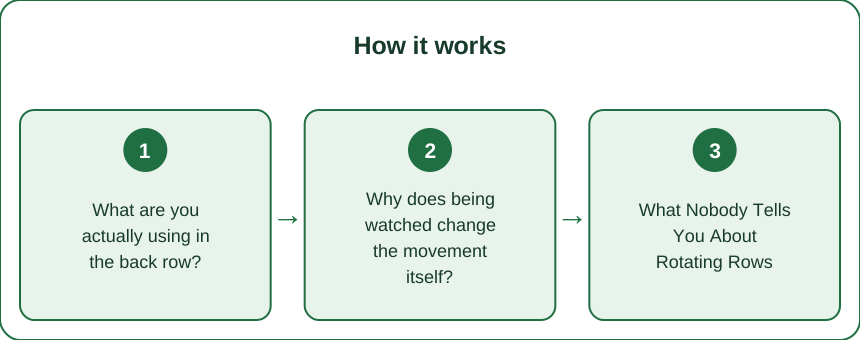
What are you actually using in the back row?
More than you realize, and none of it is consciously chosen.
Peripheral movement cues. With dancers in front of you, your visual field is full of information about what comes next — and you process it far faster than you could process a memory. Even when you’re certain you know the choreography, part of you is confirming against the room. Move to the front and that confirmation vanishes.
The permission to be a beat late. In the back, being a hair behind is invisible and, more importantly, functional — reacting to what you see is a fundamentally different mental task from initiating from memory. Reaction is faster and easier than recall. In the front, there’s nothing to react to, so you have to generate the timing yourself.
Reduced observation. Whether or not anyone is actually watching you matters less than whether you feel watched. Feeling observed reliably shifts attention inward toward monitoring your own movement — which is exactly the wrong place for attention to be while dancing.
Mirror distance. From the back, the mirror is far enough that you see your whole shape. From the front, you’re close enough to see your face and hands in detail, which invites the kind of piece-by-piece self-inspection that fragments a movement.
Why does being watched change the movement itself?
Because dancing well requires the movement to run automatically, and attention to it interrupts that.
Once choreography is learned, execution runs largely without conscious control. That’s the goal — it’s why practice matters. But conscious attention directed at an automated skill degrades it. Musicians know this as choking; the mechanism is the same when you start consciously steering a movement your body already knew how to do.
Feeling watched pulls attention inward almost automatically. And the specific quality people describe when they move forward — looking stiff, arms feeling wrong, transitions going choppy — is precisely what conscious control produces. You’re checking each piece instead of letting the sequence run.
There’s a second effect worth naming: anticipatory tension. Nerves increase baseline muscle tone, and elevated tone shortens range of motion and slows transitions. So you’re not imagining that your movement got smaller in the front row. It did, by a few degrees at every joint, which is more than enough to read as stiff from outside.

What Nobody Tells You About Rotating Rows
Here’s the thing most classes never say out loud: the back row is where you learn, and the front row is where you test. They’re different activities, and mixing them up costs people months.
The common mistake is treating the front row as a reward for getting good. So dancers stay in the back until they feel ready, and stay in the back forever, because the readiness they’re waiting for is only built by being in front.
The other mistake is the reverse — jumping to the front on day one with unfamiliar choreography and concluding from the resulting mess that you’re not progressing. You were doing two hard things at once.
The useful sequence is the boring one:
- Learn it in the back with full visual reference, until the sequence runs without hunting for the next move
- Move to the middle where you have partial reference on one side
- Take the front once the choreography is genuinely in your body, not just recognizable
The front row is a skill you train separately from the choreography. It has its own learning curve, and it transfers to every combo afterward — which is why it’s worth deliberately practicing rather than waiting to feel ready for.
How do you keep the back-row version of yourself?
Four things that work, in rough order of how quickly they help.
Give your attention an external target. Instead of monitoring your body, aim attention outward — at the beat, at a fixed point on the wall, at the quality you want the movement to project. External focus consistently outperforms internal focus for movement execution, and it directly interrupts the self-monitoring loop.
Take the front row on choreography you’ve fully absorbed. Don’t debut the front row on a new combo. Use a piece you’ve had for weeks, so the only new variable is the position.
Deliberately let the first run be worse. Going in expecting a clean first attempt guarantees you’ll be monitoring for errors from count one. Decide beforehand that run one is a throwaway and you’ll actually let it run.
Practice at home without a mirror. Most people learn choreography almost entirely with visual self-feedback, then lose it when they can’t check. Running a combo facing a blank wall builds the internal sense of position that the front row demands — and it’s the single practice habit that most reliably transfers.
One reframe worth holding onto: the back-row version isn’t your real ability and the front-row version isn’t either. Your ability is the range between them, and the range narrows with exposure. Every class you spend in front is what narrows it.
FAQ: Class Position Questions, Answered
Should I ask to stay in the back if I’m struggling?
For a combo you’re still learning, yes — that’s what the back is for. But set a marker: once you can run it twice without hunting for the next move, move up. Waiting for it to feel comfortable in the back means waiting forever.
Why do I dance better when the teacher isn’t looking?
Same mechanism, smaller dose. Being observed pulls attention inward toward self-monitoring, and self-monitoring interferes with movement that’s supposed to run automatically. The fix is the same — external focus on the beat or the movement’s quality rather than on your body.
Does this ever go away?
The gap narrows substantially with exposure, and for most dancers it stops mattering. It rarely disappears entirely, and it doesn’t need to — experienced performers describe the same shift and simply have more practice working through it. Front-row tolerance is trained, not innate.
TL;DR:
- The back row gives you visual reference, permission to react rather than initiate, and less felt observation — losing all three at once makes the front genuinely harder.
- Feeling watched pulls attention inward, and conscious attention degrades movement that’s supposed to run automatically.
- Learn in the back, test in the front — they’re different tasks, not a ranking.
- Use external focus, debut the front row on familiar choreography, and practice at home without a mirror.
Take the front row this week on the combo you know best, and expect the first run to be worse. That’s the whole training effect — and it’s the one thing the back row can’t teach you.
Keep Reading
This article is for general informational and styling purposes only. Fit, sizing, and product availability may vary.