Why You Completely Freeze Up the Moment Hip-Hop Class Opens Up to Freestyle
You can follow choreography just fine, even complex sequences — and the second the instructor says ‘now freestyle for eight counts,’ your body locks up completely. That gap between structured and unstructured movement is a real, specific skill gap, not a lack of ability.
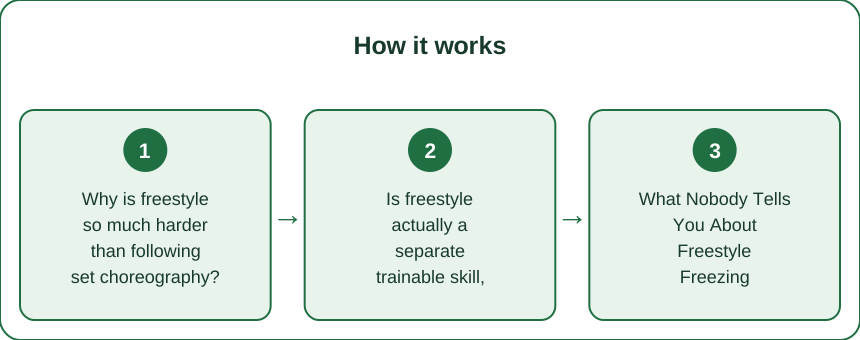
Why is freestyle so much harder than following set choreography?
Choreography removes the decision-making burden entirely — you’re executing a pre-planned sequence, which is a genuinely different cognitive task than freestyle, where you’re simultaneously generating movement ideas and executing them in real time. Freestyle asks your brain to do two demanding jobs at once that choreography splits apart and only asks for one.
Is freestyle actually a separate trainable skill, or just about confidence?
It’s a genuinely separate trainable skill, not purely a confidence issue — freestyle ability improves specifically through freestyle practice, the same way choreography retention improves through choreography practice. Confidence often improves as a byproduct of skill improvement here, rather than confidence alone unlocking freestyle ability.
What Nobody Tells You About Freestyle Freezing
Here’s what’s rarely said in class: most dancers, including experienced ones, went through this exact freeze phase — freestyle comfort is one of the later skills to develop in most people’s dance journey, well after choreography competence, and it’s genuinely common for someone to be quite strong at set choreography while still building freestyle comfort separately.
What actually helps build freestyle comfort specifically?
Practicing freestyle alone at home, with no audience, focused on just moving to music without judging the output, builds the specific muscle of generating movement in real time without the added social pressure of a class setting. Starting with just isolating one body part (arms only, or footwork only) for a full song, rather than trying to move your whole body freely at once, breaks the skill into a more manageable first step.
FAQ: Hip-Hop Freestyle Questions, Answered
Is it normal to feel worse at freestyle than at choreography even after years of dancing?
Yes, this is a very commonly reported experience — the two are genuinely different skills that develop somewhat independently.
Does watching freestyle videos help you get better at it?
It can help build a mental vocabulary of movement ideas, but actual practice generating your own movement is what most directly builds the skill.
How long does it typically take to get more comfortable with freestyle?
Many dancers report noticeable improvement within a few months of regular, low-pressure freestyle practice, though comfort levels vary a lot by individual.
TL;DR:
- Freestyle asks your brain to generate and execute movement simultaneously, unlike choreography which only asks for execution
- Freestyle is a genuinely separate trainable skill, improved through freestyle practice specifically
- Most dancers, even experienced ones, go through this exact freeze phase — it’s not a sign of low ability
- Low-pressure solo practice, starting with just one body part, builds the skill more manageably
The freeze isn’t a confidence failure — it’s just a different, later-developing skill that hasn’t had its own practice time yet.
Keep Reading
This article is for general informational and styling purposes only. Fit, sizing, and product availability may vary.