Why Your Energy Falls Off a Cliff in the Second Half of Hip Hop Class
Quick Answer: The second half of a hip hop class is where full run-throughs happen, and full-out dancing is a different physiological demand from learning eight-counts. You have also spent 40 minutes on concentration-heavy learning, which is genuinely fatiguing, and most people under-fuel and under-hydrate for an evening class. The drop is usually cognitive load plus anaerobic demand arriving at the same time, not a fitness ceiling.
The first 45 minutes feel fine. Then the music goes on full, the class runs the combination three times in a row, and by the second run-through your legs are gone and your brain has stopped supplying the next move.
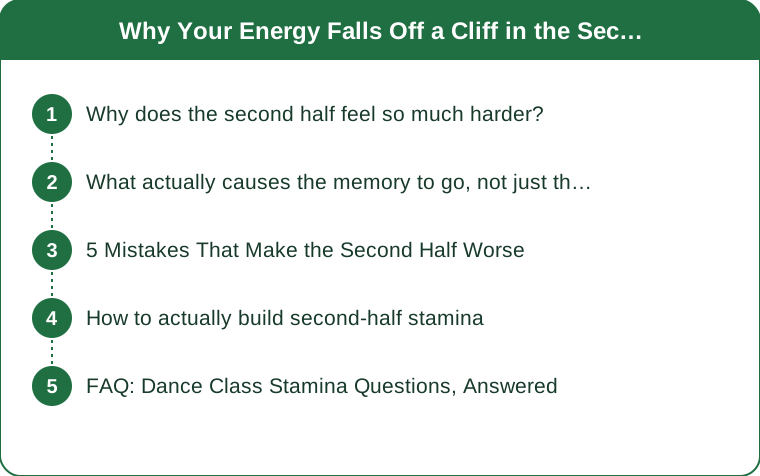
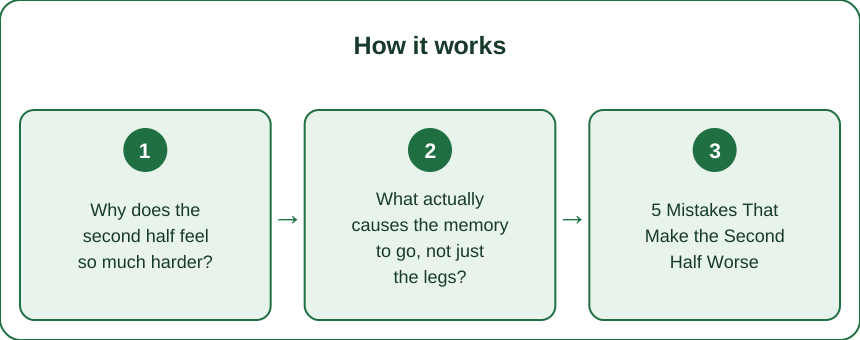
Why does the second half feel so much harder?
Three different things change at once, and they compound.
The physiological demand changes shape. Learning choreography is stop-start: eight counts, a pause, a correction, a repeat. Full run-throughs are continuous, high-intensity, largely anaerobic work with limited recovery. Going from intermittent to continuous mid-class is effectively switching workouts, and the second one is much harder.
Cognitive load has been accumulating the whole time. Learning and retaining new movement sequences is genuinely demanding. Working memory is finite, and by the second half you have spent most of it. This is why the moves you knew at minute 30 evaporate at minute 55 - the recall demand rises exactly as your capacity to meet it falls.
Fuel status is often poor. Evening classes commonly follow a working day where lunch was hours earlier. Glycogen availability affects both high-intensity output and cognitive performance, and dance classes tax both.
Full-out dancing includes constant impact. Jumps, drops, level changes, and floor work involve eccentric loading that fatigues muscle faster than steady-state movement. Marking a combination and dancing it full-out are not remotely the same physical cost.
And there is an emotional component. Run-throughs are when you are watched, filmed, and compared. Performance stress raises heart rate and breathing independently of physical effort, which makes the same choreography feel harder in the second half than the first.
What actually causes the memory to go, not just the legs?
This is the part dancers find most frustrating, and it has a clear explanation.
Physical fatigue degrades motor recall. Movements learned recently are held in a fragile state, and executing them under fatigue is a substantially harder task than executing them fresh. This is why you can nail a section slowly at minute 20 and lose it entirely at tempo at minute 55.
Divided attention makes it worse. In a full run-through you are tracking music, spacing, other dancers, the mirror, and the choreography simultaneously. Each of those competes for attention that was fully available during slow learning.
Breathing changes recall too. Working hard means breathing hard, and irregular breathing disrupts the rhythmic anchoring that helps dancers hold sequences. Dancers who hold their breath through hard sections lose choreography faster than those who do not.
Retrieval is a skill you can practise separately. Most people practise executing choreography rather than recalling it. Running a section from memory without music, standing still, builds the recall pathway independently of the physical one.
The practical implication: if your combination falls apart only in the second half, the problem is usually not that you have not learned it. It is that you have only learned it in the easy condition.
5 Mistakes That Make the Second Half Worse
1. Going full-out during the learning phase. Dancers who dance every repetition at 100% while learning arrive at the run-throughs already depleted. Professionals mark - moving through the choreography at reduced intensity - precisely to preserve output for when it counts.
2. Skipping water because there is no obvious break. Even modest dehydration affects both physical output and cognitive function, and a heated studio full of moving people is a high-sweat environment. Drink during the corrections, not just at the scheduled break.
3. Not eating before an evening class. A class at 7pm after lunch at 12:30 is a class fuelled by nothing. A small carbohydrate-containing snack 60-90 minutes before makes a substantial difference to the second half specifically.
4. Holding your breath through hard sections. Extremely common with sharp, staccato hip hop movement, where dancers unconsciously breath-hold to hit accents. It raises perceived effort sharply and accelerates fatigue. Deliberately exhaling on the biggest accents fixes it.
5. Treating the second half as a fitness verdict. The dancer struggling at minute 55 concludes they are unfit and adds cardio. The real gaps are usually fuelling, marking discipline, and recall practice - all of which are faster to fix than aerobic capacity, and all of which produce visible improvement within a few classes.
How to actually build second-half stamina
Targeted changes beat generic conditioning.
Mark deliberately during learning. Learn the shapes at 60-70% and reserve full-out for when the class runs it. This single change transforms the second half for most people.
Practise recall without the physical load. Run through the combination in your head, or standing still marking with hands, on the train home or the next morning. Ten minutes of pure retrieval practice does more for second-half memory than an hour of dancing it.
Add short, sharp conditioning outside class. The demand in a run-through is repeated bursts of near-maximal effort with short recovery. Intervals of 30-45 seconds hard with 60-90 seconds rest match that profile better than steady cardio.
Train single-leg strength and landing control. Hip hop involves constant level changes, drops, and unilateral loading. Squats, step-downs, and calf work improve the durability of exactly the tissue that gives out first.
Fuel the class properly. Something with carbohydrate 60-90 minutes ahead. This is not optional for evening classes after a long working day.
Film yourself in the second half, not the first. Most dancers film early run-throughs when they look best. Filming the tired ones shows where technique actually degrades, which is where the useful information is.
And be realistic about class structure. Some classes are simply built with an intense back half. Being tired at minute 55 of a demanding class is not a failure - it is what the class is designed to produce.
FAQ: Dance Class Stamina Questions, Answered
Why do I forget choreography when I get tired?
Because recently learned movement is held fragilely, and physical fatigue plus divided attention degrades retrieval. You learned it in a calm, slow, low-demand condition, and the run-through asks you to retrieve it in the opposite condition.
Should I do more cardio to survive class better?
Some, but match the format. Full run-throughs are repeated high-intensity bursts, so intervals of 30-45 seconds hard with 60-90 seconds recovery transfer far better than long steady sessions.
Is it normal to be exhausted after one hour of dance?
Completely. Full-out dancing is high-intensity, high-impact work with a substantial cognitive load layered on top. It is more demanding than most people expect, and the fatigue is not evidence of poor conditioning.
What should I eat before an evening dance class?
Something containing carbohydrate, 60-90 minutes before - toast with banana, yoghurt with fruit, or a small sandwich. The most common cause of a collapsing second half in evening classes is simply not having eaten since lunch.
How do I stop running out of energy during run-throughs?
Mark during the learning phase instead of dancing everything full-out, breathe deliberately on accents rather than holding, drink during corrections, and eat beforehand. Those four changes fix the second half for most people faster than any conditioning programme.
TL;DR:
- Run-throughs are a different physiological demand from learning, and the switch happens exactly when you are most depleted.
- Cognitive load from learning is genuinely fatiguing, which is why memory goes at the same time as legs.
- Marking during the learning phase is the single highest-value habit for surviving the second half.
- Evening classes after a long day are usually under-fuelled; a carb snack 60-90 minutes ahead changes everything.
- Practise recall separately from execution - most dancers only ever rehearse the easy condition.
You are not out of shape at minute 55. You have spent 45 minutes learning, danced every repetition full-out, and eaten nothing since lunch.
Keep Reading
This article is for general informational and styling purposes only. Fit, sizing, and product availability may vary.