Why Your Moves Look Different in the Mirror Than on Video
Quick Answer: The mirror shows you a flipped, frozen, self-corrected version of your dancing, and the camera does not. Three specific things cause the gap: the mirror image is laterally reversed so your brain has spent years liking that version of your face and body, you unconsciously time your look at the mirror to the moment the move is at its best, and mirror-watching pulls your head and eyeline off where the choreography wants them. Video is closer to what an audience sees. That is the bad news and also the entire training tool.
Every dancer goes through this. The ones who improve fastest are the ones who film early and stop treating the video as an insult.

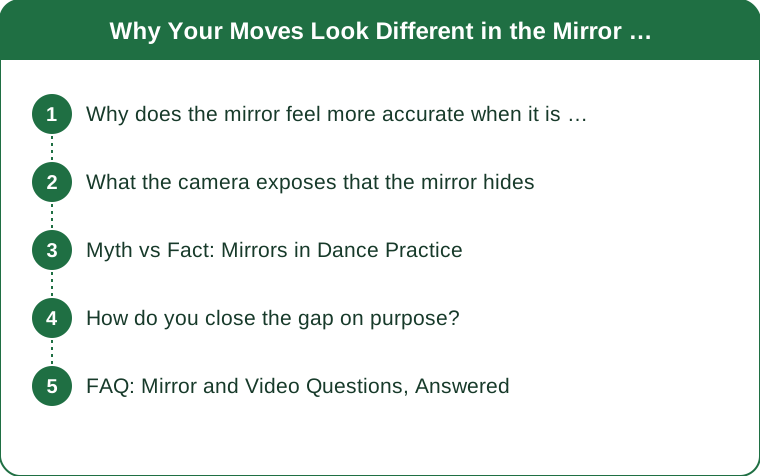
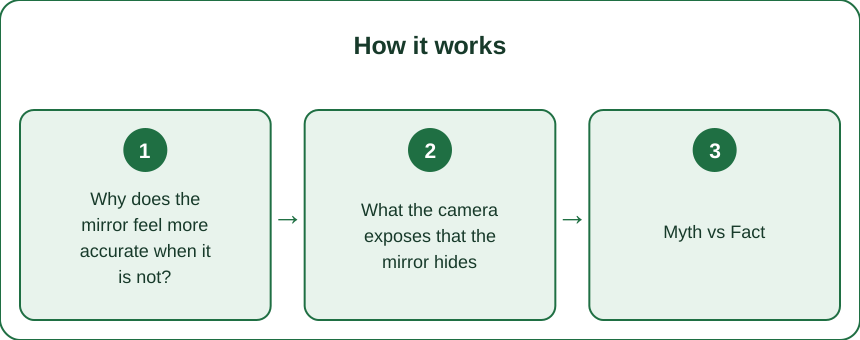
Why does the mirror feel more accurate when it is not?
Because you have far more practice looking at it.
Mere exposure. You have seen your mirror image tens of thousands of times and your video image perhaps a few dozen. We reliably prefer the version of a face we have seen most, which is the reversed one - and the effect is strong enough that photos of us often feel subtly wrong to us while feeling completely normal to everyone else. Applied to a whole moving body, the effect gets larger, not smaller.
Selective sampling. This is the bigger one and almost nobody notices it. You do not watch the mirror continuously - you glance. And you glance at the moments you feel confident, which are the moments the move is landing. The transitions, the recovery beats, the split second where the weight has not shifted yet - your eyes are elsewhere for all of those, and those are exactly what the camera keeps.
Real-time correction. You see the mirror and adjust within a fraction of a second, so the version you remember is the corrected one. The camera records the pre-correction version, which is the version that actually happened.
So the mirror is not lying. It is showing you a highlight reel assembled by your own attention.
What the camera exposes that the mirror hides
Once you start filming, the same list of things shows up for almost everybody.
Timing, and specifically lateness. Watching yourself in a mirror puts you a beat behind, because you are responding to what you see rather than driving the move from the music. On video this reads as consistently slightly late, and it is the most common single note beginners get.
Your head and eyeline. Mirror practice trains your gaze forward at your own reflection. Hip hop lives on head direction and focus, so the mirror-trained version looks flat - technically correct, visually blank.
Level changes. Mirrors are vertical and you view yourself straight on, so you consistently underestimate how much you are or are not dropping into the floor. Video from the front makes this obvious immediately, and it is usually the difference between a move reading as bouncy and reading as heavy in the good way.
Where the movement stops. Bounce and groove are about the settle, not the hit. The mirror shows you the shape; the camera shows you the moment the shape arrives, which is the part that actually carries the groove.
Arm finish. Arms that felt fully extended almost never are. The mirror glance catches the intent, the camera catches the actual endpoint.

Myth vs Fact: Mirrors in Dance Practice
Myth: The camera adds something and distorts you. Fact: Lens choice and angle do change proportions - a phone held close and low distorts noticeably - but from a normal distance at chest height the video is far closer to the audience view than the mirror is.
Myth: You should train without mirrors entirely. Fact: Mirrors are excellent for a specific job - checking a shape, a line, or an isolation while learning it slowly. They are poor for run-throughs. Use them for the first pass, then turn away.
Myth: Feeling good means it looks good. Fact: They correlate loosely at best, and early on they can be inversely related. The move that feels most comfortable is often the one you are under-committing to, and the one that feels excessive usually reads as normal on camera.
Myth: You need to look at yourself to learn the choreography. Fact: You need to look at yourself to learn the shape. Learning the dance happens once the mirror is out of it, because the timing has to come from the music rather than from the reflection.
How do you close the gap on purpose?
The gap closes with a specific practice pattern, not with more repetition of the same practice.
Film early and film often. The instinct is to wait until it looks good enough to film, which means you only ever film what is already working. Film the second run-through of anything new - the ugly footage carries the most information.
Practice in thirds.
- First third facing the mirror, slow, learning the shapes and checking lines
- Second third facing away from the mirror, at tempo, driving the timing from the music
- Final third on camera, full out, no mirror at all
Set the camera properly. Chest height, three to four metres back, whole body in frame with headroom. A low phone propped against a bag distorts your proportions and will make you feel worse about your dancing than you should.
Watch the video twice with different jobs. First pass, watch only timing - is the hit on the beat. Second pass, watch only one body part. Trying to fix everything from one viewing produces nothing but discouragement, which is why most people watch their footage once, feel bad, and never open the file again.
Compare footage across weeks, not against the instructor. Your own video from three weeks ago is the only fair benchmark, and it is usually a much more encouraging one than you expect.
FAQ: Mirror and Video Questions, Answered
Why do I look stiff on video when I felt loose?
Usually because the mirror let you check shapes rather than commit to weight. Looseness on camera comes from the settle after each move and from the head and shoulders travelling with the body. Try one run-through at what feels like an exaggerated level of commitment and watch it back - it almost always reads as normal rather than too much.
Should I stop using mirrors completely?
No. Use them for slow, isolated shape work where seeing the line is genuinely useful, and turn away for anything at full tempo. The problem is not mirrors, it is doing every single repetition in front of one.
How long does it take to stop hating your own footage?
Most people report the sharp discomfort fading after four to six weeks of filming regularly, largely because of the same exposure effect that made the mirror feel comfortable in the first place. The footage does not change that fast. Your familiarity with it does.
TL;DR:
- The mirror is reversed, self-corrected, and sampled at your best moments - it is a highlight reel
- Video exposes timing lateness, blank eyeline, shallow level changes, and unfinished arms
- Mirror-watching makes you late because you react to the reflection instead of driving from the music
- Practise in thirds: mirror slow, away from mirror at tempo, then on camera full out
- Film chest height and a few metres back; a low close phone distorts and discourages
The fastest change most dancers can make is to film the ugly second run-through instead of the polished tenth. Compare yourself to your own footage from three weeks ago and the gap starts closing quickly.
Keep Reading
This article is for general informational and styling purposes only. Fit, sizing, and product availability may vary.