Why Your Moves Look Clean but the Transitions Look Choppy
Quick Answer: Transitions look choppy because you are learning choreography as a series of destination shapes rather than as continuous movement. Your brain stores the poses and improvises the path between them, which produces a stop-start quality. The fix is to practise the connections deliberately — slow the section down, identify where your weight travels, and rehearse the in-between rather than the positions.
You film yourself. Every position matches the video.
And yet it looks nothing like the video, because the video flows and yours arrives.
This is one of the most solvable problems in dance, and almost nobody practises the thing that fixes it.
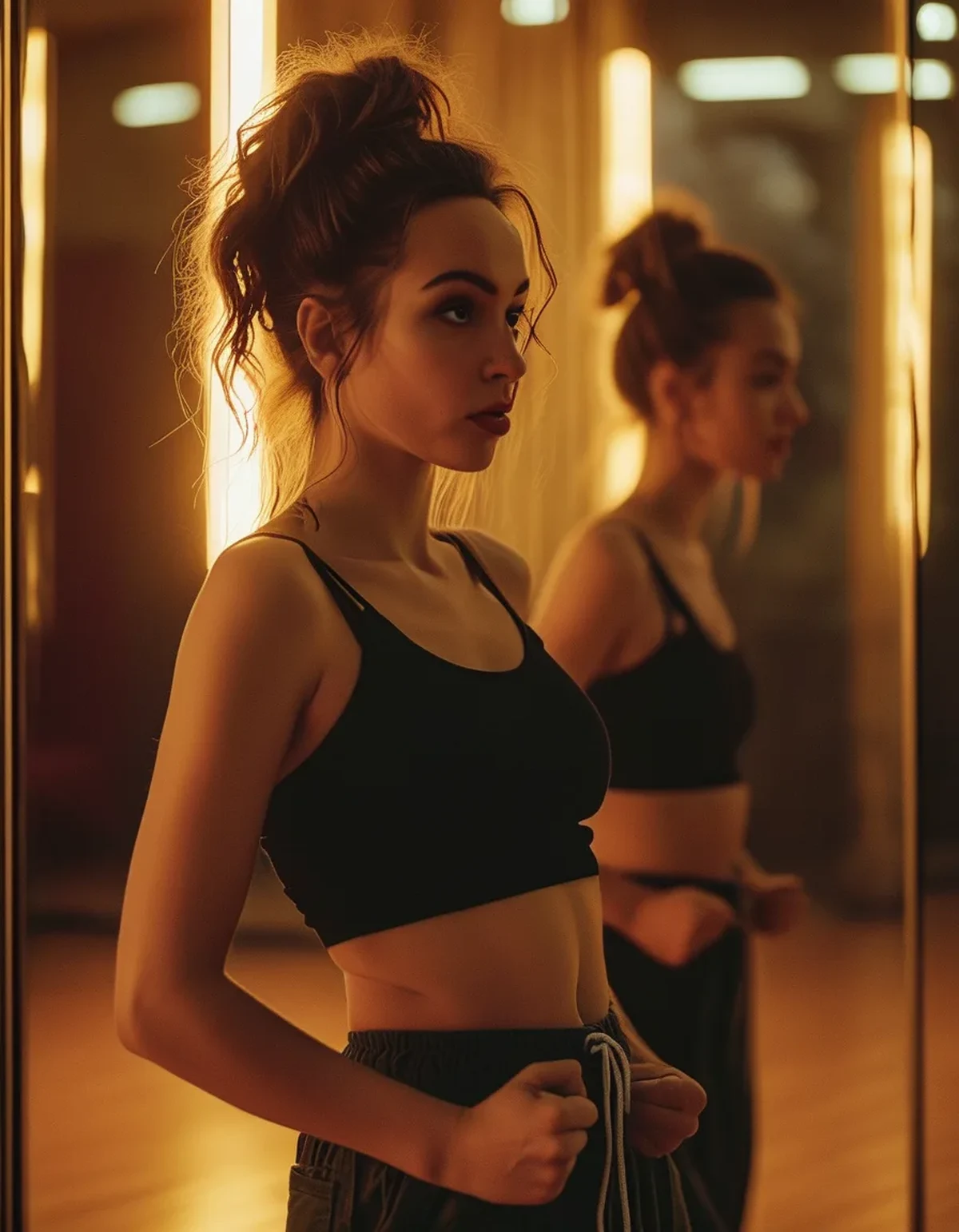
Why does learning by positions cause this?
Because of how choreography is usually taught and how memory encodes it.
Instructors teach in chunks with pauses. They demonstrate, break it down, hold the shape so you can see it, then move on. That pausing is essential for learning and it is also exactly what you accidentally memorise. You store move A, move B, move C — and the pause between them comes along for free.
Your brain fills gaps with the most efficient path, not the intended one. If you never explicitly learned how to get from A to B, your motor system will find some way to get there. That way is usually the shortest and stiffest available, because efficiency is what it optimises for in the absence of other instruction.
Positions are easier to remember than paths. Static shapes are visually distinct and easy to encode. Movement quality between them is continuous, subtle, and much harder to hold in memory — so it gets dropped first under pressure.
Under tempo, the gaps become visible. Slowly, you have time to improvise a passable connection. At full speed, there is no time, so you snap between shapes. This is why a combination often looks worse fast than slow, even when you know it perfectly.
The result is a specific look: each move lands correctly and then everything stops for a fraction of a beat. Audiences read that as choppy without being able to say why.
What is actually missing?
Three things, and they are trainable separately.
Weight transfer is the biggest one. In hip hop, movement is driven from the ground up — the weight shifts and the body follows. Dancers who look smooth are continuously moving weight between feet, and the visible moves are consequences of that. Dancers who look choppy hold weight still and move limbs, then reposition the weight abruptly when they run out of options.
The bounce or groove has to persist through the transition. The characteristic bounce is not decoration on top of the moves, it is the continuous pulse underneath everything, including the parts between moves. When the bounce stops during a transition, the whole section reads as disconnected — and the bounce stopping is almost always what people are actually seeing when they say a transition looks bad.
Momentum should carry into the next move. Each move ends with the body travelling in some direction. Smooth dancers let that momentum initiate the next thing. Choppy dancers stop the momentum, reset, and start the next move from stillness, which costs energy and time.
A useful diagnostic: film a section and watch it with the sound off, focusing only on your hips and feet. If they go still at any point, you have found the choppy spot, and it will almost always be in the transition rather than the move.
5 Drills That Fix Transitions
1. Practise only the connections. Take two consecutive moves and drill just the last count of A into the first count of B, on repeat, twenty times. Skip everything else. This feels tedious and is by far the highest-yield thing on this list, because it is the only drill that treats the transition as material worth rehearsing.
2. Run it at half tempo without stopping. Not slow with pauses — slow and continuous. The rule is that the body never fully stops. At half speed you have time to notice exactly where you were about to freeze, and you can build a real path there instead of an improvised one.
3. Exaggerate the weight shift. Run the combination deliberately over-shifting your weight from foot to foot, far more than the choreography calls for. It will look wrong and feel ridiculous. Then dial it back to normal, and the transitions will hold the continuity that the exaggeration built in.
4. Keep the bounce running through everything. Practise the section with a constant, audible bounce — literally counting or breathing on the pulse — and refuse to let it stop, even during the parts you find hardest. The moves will initially get sloppier. The flow arrives before the precision comes back.
5. Film from the side, not the front. Front-on filming shows shapes, which you are already good at. A side view shows travel, weight and momentum — the exact things that are missing. Most dancers have never seen themselves from the side, and it is where the choppiness is visible.
How long does this take to change?
Faster than you expect, because it is a reframing more than a skill build.
The first improvement usually comes in one session. Simply understanding that transitions are material to be rehearsed changes what you practise, and that alone tends to produce a visible difference within a week.
The deeper change takes longer. Consistently smooth dancing requires the groove to be automatic enough that it survives under pressure — new choreography, fast tempo, being watched. That is a matter of months of accumulated practice, not a drill you complete.
Do not chase precision and flow in the same rep. They pull against each other early on. Run a section for flow, accepting that the shapes get loose, then run it for precision, accepting that it gets stiff. They converge on their own after enough reps of each.
Expect it to regress under new material. When you learn a new combination, the transitions will be choppy again, because you are back to storing positions. That is not lost progress — it is the normal sequence, and it resolves faster each time.
One practical note about returning to class. After a summer of irregular practice, the groove is usually the first thing to fade and the first thing to come back. If autumn classes feel stiff for the first two or three weeks, that is expected. Prioritise bouncing to music at home over drilling combinations, and the transitions will recover faster than if you drill shapes.
FAQ: Dance Transition Questions, Answered
Why do I look fine slow but bad at tempo?
Because at slow speed you have time to improvise the connections. At tempo you do not, so the gaps in what you actually learned become visible. Drill the connections specifically.
Is this a strength or flexibility problem?
Rarely. It is almost always a practice-content problem — you practised the positions and not the paths. Strength matters for control at speed, but it is not the usual cause.
Should I learn choreography differently?
Yes, in one small way: after learning a section, immediately run it slowly and continuously before speeding up. That single habit prevents the pauses from being encoded in the first place.
Does this apply to freestyle too?
Even more so. Freestyle that looks choppy is usually a dancer cycling through a list of moves rather than letting one flow into the next. The same weight-transfer drills help directly.
How do I know which transition is the problem?
Film it, watch with no sound, and look only at your hips. The moment the hips go still is the moment the transition breaks.
Will practising to slower music help?
Yes, provided the music still has a clear pulse. Practising in silence removes the groove entirely, which tends to reinforce the position-to-position habit.
TL;DR:
- Choppiness comes from learning destination shapes and improvising the path between them.
- Smooth movement is driven by continuous weight transfer and a bounce that never stops.
- Drill the connections themselves — just the last count of one move into the first of the next.
- Run sections slow and continuous, never slow with pauses.
- Film from the side to see travel and momentum, which front-on filming hides.
Rehearse the in-between and the moves take care of themselves.
Keep Reading
This article is for general informational and styling purposes only. Fit, sizing, and product availability may vary.